

How Businesses Can Grow Online Through Organic Marketing?
Organic marketing helps businesses attract and engage audiences through valuable content, search engine visibility, social media activity, and other non paid marketing channels. Rather than relying entirely on advertising budgets to reach potential customers, businesses can develop a consistent online presence that attracts people who are already interested in their products, services, or expertise.
However, organic marketing requires more than publishing regular social media posts or occasionally updating a website. Businesses need a clear understanding of their target audience, relevant search behaviour, content priorities, and the channels most likely to support their objectives.
When implemented effectively, organic marketing can help businesses build credibility, strengthen brand recognition, and create opportunities for long term customer relationships. Understanding how these strategies work together can help businesses develop a more sustainable approach to digital growth.
What Is Organic Marketing and Why Does It Matter?
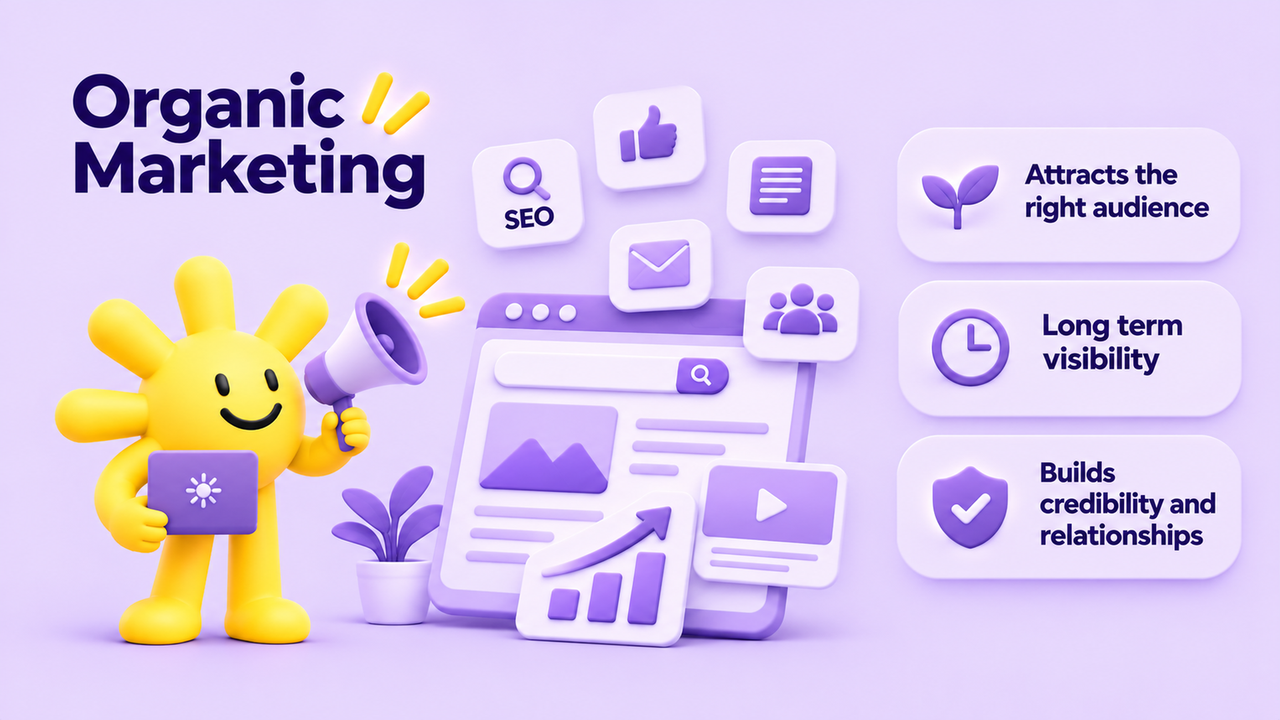
Organic marketing refers to marketing activities that attract audiences without paying directly for each placement or click. Common examples include search engine optimisation (SEO), organic social media content, educational blog articles, email newsletters, and community engagement.
These activities help businesses reach people through relevant information, useful resources, and consistent communication rather than relying exclusively on paid advertising.
For example, a business publishing informative articles about its industry may attract visitors through search engines. Similarly, a company sharing practical advice on LinkedIn or Instagram may build an audience that becomes familiar with its expertise over time.
One of the main advantages of organic marketing is that valuable content can continue attracting attention after its initial publication. However, results are not guaranteed. Search competition, content quality, platform algorithms, and audience demand all influence performance.
Organic marketing should therefore be treated as a long term investment in visibility, credibility, and audience relationships rather than an immediate replacement for paid campaigns.
How Can Businesses Use SEO to Attract Organic Traffic?
Search engine optimisation helps businesses improve the visibility of their websites in relevant search results. By understanding what potential customers search for, businesses can develop pages and resources that answer questions, explain services, and address specific needs.
An effective SEO strategy begins with keyword research. Businesses should identify the search terms their audiences use when researching problems, comparing solutions, or evaluating service providers.
These insights can inform website content, service pages, blog articles, and frequently asked questions. Each page should have a clear purpose and provide useful information that satisfies the visitor's intent.
Businesses should also pay attention to technical SEO, including website speed, mobile usability, internal linking, indexing, and site structure. These factors help search engines discover and understand website content.
For example, a company offering professional services could publish an article explaining a common industry challenge and link it to a relevant service page. This creates a pathway from informational searches to further exploration of the company's offering.
SEO performance should be evaluated through organic clicks, relevant impressions, search rankings, engaged website visits, enquiries, and conversions. Ranking improvements alone are insufficient if the traffic does not reach the right audience or contribute to business objectives.
How Can Organic Social Media Marketing Build Brand Awareness?
Organic social media marketing helps businesses develop relationships with audiences through regular, relevant content without paying to distribute every post. The objective is not simply to maintain an active account. Businesses should publish content that reflects their expertise, communicates their value, and encourages meaningful interactions.
Different content formats can serve different purposes. Educational content, such as practical advice, industry insights, and tutorials, helps audiences solve relevant problems. Behind the scenes content makes businesses more relatable by showing how products are developed, how teams work, or how services are delivered.
Thought leadership allows businesses to share professional insights, informed perspectives, and original ideas that demonstrate industry knowledge. Similarly, customer focused content can address common questions, highlight customer challenges, and explain how the business delivers value. Community engagement also plays an important role through responding to comments, participating in relevant discussions, and interacting with industry communities.
Businesses should select platforms based on audience behaviour and communication objectives rather than attempting to maintain an equally active presence everywhere. Consistency also matters, but publishing frequency should remain manageable. A realistic content schedule that prioritises relevance and quality is generally more useful than producing large volumes of repetitive posts.
How Can Content Marketing Support Organic Growth?
Content marketing allows businesses to attract audiences by providing information that is useful, relevant, and aligned with their interests. It can support organic visibility across search engines, social media platforms, email communications, and other digital channels.
A practical content strategy begins by identifying the questions customers ask at different stages of their decision making process.
For example, someone unfamiliar with a product may need educational content explaining the problem it solves. Someone comparing alternatives may benefit from detailed guides, comparisons, or case studies. A potential customer closer to making a decision may want service explanations, demonstrations, or evidence of previous results.
Businesses can organise these topics into content categories that reflect their expertise and audience needs. Blog articles can address detailed questions, while social media posts can communicate key insights in shorter formats.
Repurposing content can also improve efficiency. A comprehensive article may provide material for several social media posts, a short video, an email newsletter, or a downloadable resource.
However, repurposing should involve adapting the message to each channel rather than distributing identical content everywhere. Each format should provide value in the context where it appears.
How Can Businesses Use Organic Marketing to Build Customer Trust?
Trust is an important factor in how customers evaluate businesses, particularly when purchasing services or making significant financial commitments.
Organic marketing can support trust by demonstrating expertise, communicating transparently, and providing useful information before asking audiences to make a purchase.
Businesses can build credibility by publishing original insights, sharing genuine customer experiences with permission, explaining their processes, and answering common questions clearly.
Case studies can be particularly useful when they describe the initial challenge, the approach taken, and the results achieved. Any performance claims should be supported by accurate evidence and presented with sufficient context.
Consistency across digital touchpoints is equally important. A business's website, social media accounts, blog articles, and other communications should convey a coherent identity and consistent messaging.
Businesses should also avoid relying on engagement figures alone as proof of trust. High follower counts or large numbers of likes do not necessarily demonstrate credibility, customer satisfaction, or purchase intent.
A more effective approach is to use organic channels to demonstrate expertise, provide evidence, and build familiarity over time.
How Can a Digital Marketing Agency Help Businesses Implement Organic Marketing?
Organic marketing involves several connected activities, including research, content development, website optimisation, distribution, and performance analysis. Managing these responsibilities effectively requires a structured strategy and consistent execution.
A digital marketing agency can help businesses identify the most appropriate organic channels, understand their target audiences, and develop a plan that connects marketing activities with business objectives.
Depending on the scope of the engagement, this may include keyword research, technical SEO, content planning, blog writing, social media management, website optimisation, and performance reporting.
An agency can also help businesses identify gaps in their existing marketing approach. For example, a website may attract search traffic but generate few enquiries because its service pages do not clearly communicate value. Alternatively, a business may publish social media content regularly without directing audiences towards useful resources or relevant next steps.
By examining these activities together, businesses can identify opportunities to improve the customer journey and use their existing resources more effectively.
When selecting a provider, businesses should evaluate its strategic approach, reporting transparency, communication process, and ability to explain how proposed activities support measurable outcomes. The objective should be to establish a clear plan rather than simply outsource individual marketing tasks.
How Can Businesses Measure the Performance of Organic Marketing?
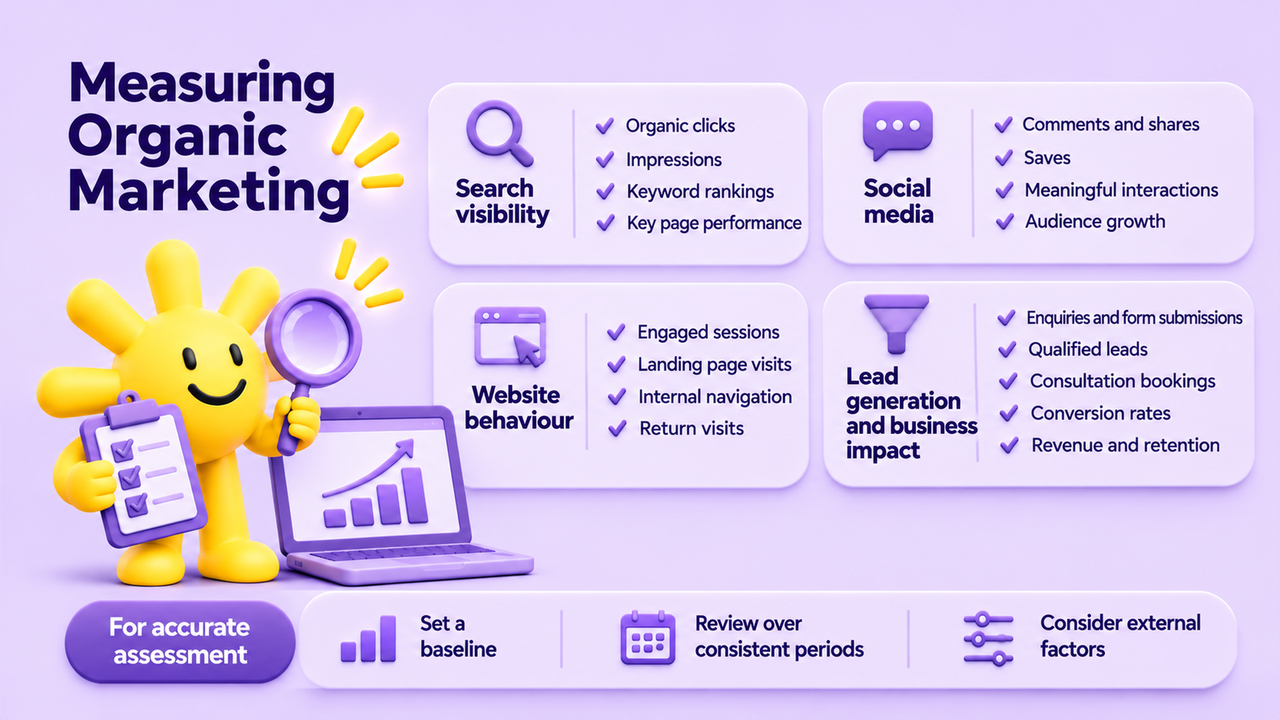
Organic marketing should be evaluated against specific objectives rather than a single headline metric. The most useful indicators depend on the channel and the outcomes the business wants to achieve. For search visibility, organic clicks, impressions, relevant keyword rankings, and the performance of important website pages can help assess SEO progress.
For social media, comments, shares, saves, meaningful interactions, and audience growth provide insights into audience engagement. Website behaviour can also be evaluated through engaged sessions, relevant landing page visits, internal navigation, and return visits to understand how audiences interact with published content.
For lead generation, enquiries, contact form submissions, qualified leads, and consultation bookings help connect marketing activities with potential commercial outcomes. Businesses can also examine conversion rates, customer acquisition costs, revenue contribution, and customer retention to gain a broader understanding of marketing effectiveness when appropriate tracking is available.
Businesses should establish baseline measurements and review performance over consistent periods. They should also account for external influences such as seasonality, search algorithm changes, competitive activity, and shifts in audience demand. Organic marketing often requires time to produce meaningful results, particularly for SEO. Regular measurement allows businesses to identify patterns, improve underperforming content, and allocate resources based on evidence rather than assumptions.
What Are the Common Mistakes to Avoid in Organic Marketing?
Although organic marketing can provide long term value, poorly planned activities may consume time without producing meaningful business outcomes. Publishing without a clear strategy can result in inconsistent messaging and limited relevance, particularly when content does not address audience needs or support specific objectives.
Another common mistake is focusing only on website traffic without considering its quality. Increased visits are not necessarily valuable if they come from audiences unlikely to become customers. Similarly, ignoring search intent and targeting keywords without answering the underlying questions may prevent content from satisfying users or performing effectively.
Businesses should also avoid expecting immediate results from organic marketing. Building visibility and audience trust generally requires consistent effort, testing, and refinement. Neglecting content updates can further reduce the usefulness of existing resources and weaken the overall quality of a website.
Finally, overlooking conversion opportunities and treating every platform identically can limit the effectiveness of organic marketing. Helpful content should provide relevant next steps, while each platform should have an approach suited to its audience and content formats. Avoiding these mistakes requires a clear strategy, a manageable publishing process, and regular evaluation of what contributes to business objectives.
Should Businesses Focus on Organic Marketing or Paid Advertising?
Organic marketing and paid advertising serve different but complementary purposes. The appropriate balance depends on the business's budget, timeline, competitive environment, and growth objectives.
Organic marketing focuses on building visibility, credibility, and audience relationships through content and other non paid activities. Paid advertising can provide more immediate distribution, targeted reach, and opportunities to test specific offers or campaigns.
For example, a business may use SEO to build long term visibility for its core services while running paid campaigns to promote a time sensitive offer. Insights from advertising campaigns may also help identify messages or audiences worth exploring through organic content.
However, organic marketing should not be treated as completely cost free. Content production, technical optimisation, specialist expertise, and ongoing management all require resources.
Businesses should evaluate both approaches based on their expected contribution, measurement capabilities, and available resources. In many cases, combining them provides greater flexibility than relying exclusively on either channel.
How Can Businesses Build a Sustainable Organic Marketing Strategy?
A sustainable organic marketing strategy requires consistency, relevance, and a clear connection between audience needs and business objectives.
Businesses should begin by identifying their most valuable audiences, selecting appropriate channels, and establishing the topics they can address with genuine expertise. They should then create a manageable publishing schedule that supports these priorities.
Content should be distributed strategically, reviewed regularly, and improved based on performance. Businesses should also ensure that their website provides useful next steps for visitors who want to learn more about their products or services.
At TSA Media Group, we help businesses connect content, search visibility, and digital marketing activities with their wider commercial objectives. Our approach focuses on building a structured online presence that supports brand awareness, audience engagement, and measurable growth.
Let's connect and explore an organic marketing strategy aligned with your business goals.
Share this Blog