
How Can Businesses Choose a Brand Development Retainer?
Building a strong brand requires more than creating a logo or selecting a colour palette. Businesses need a consistent approach to positioning, visual identity, messaging, and communication to establish recognition and build meaningful relationships with their audiences.
As businesses grow, their branding requirements often become more complex. New marketing campaigns, product launches, digital platforms, and changing customer expectations create an ongoing need for strategic guidance and creative support. Managing these requirements through separate projects can lead to inconsistent messaging, disconnected visual elements, and repeated onboarding costs.
A retainer offers an alternative by providing ongoing access to branding expertise and creative support through an agreed monthly arrangement. Rather than treating every branding requirement as an isolated project, businesses can work with a strategic partner to strengthen their identity, maintain consistency, and adapt their brand as their objectives evolve.
Choosing the right arrangement requires an understanding of existing challenges, future requirements, service scope, and the level of support needed. By evaluating these factors, businesses can identify a retainer that supports long term growth rather than simply delivering individual creative assets.
Why Should Businesses Invest in a Brand Development Retainer?
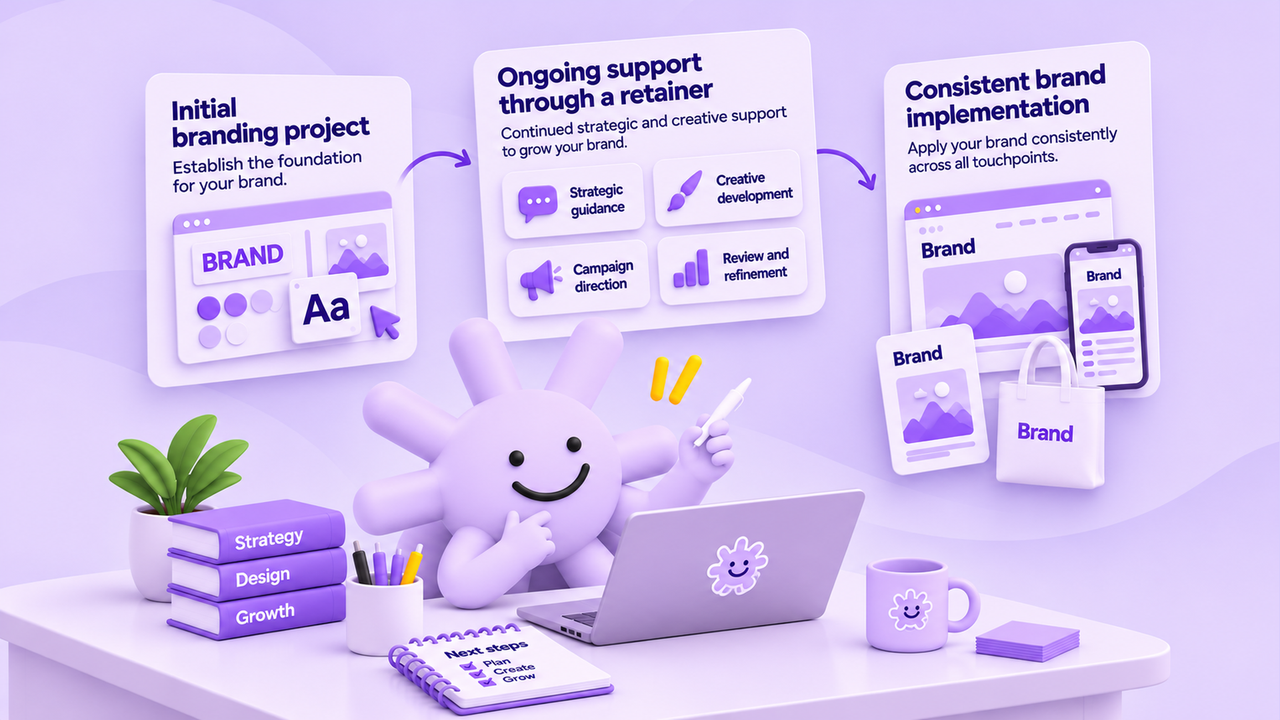
Building and maintaining a recognisable identity is an ongoing process. While an initial branding project establishes the foundation, businesses often need continued support to apply that direction consistently across their marketing and communications.
A retainer can provide access to strategic consultation, visual identity development, brand messaging, campaign direction, and creative execution, depending on the agreed scope.
For example, a growing business may need to refine its messaging as it enters new markets, develop campaign concepts that align with its positioning, or ensure that its digital and offline communications reflect the same identity.
Working with a consistent creative partner can help maintain continuity across these activities. It also creates opportunities to review existing materials, identify inconsistencies, and make informed adjustments as the business evolves.
However, a retainer is not necessary for every organisation. Businesses that require a one time logo or a clearly defined rebranding project may be better suited to a project based engagement. A recurring arrangement becomes more relevant when strategic input, creative development, and implementation are ongoing requirements.
How Can Businesses Identify Their Branding Needs?
Before comparing retainers, businesses should understand where their brand currently stands and what they need to improve. Without this assessment, they risk paying for services that do not address their most important challenges.
Businesses should begin by evaluating their brand positioning and whether it is clearly differentiated from competitors, communicating a compelling reason for customers to choose it. They should also assess their visual identity, including how consistently the logo, typography, colours, imagery, and other visual elements are applied across relevant touchpoints. Equally important is brand messaging, ensuring that the business communicates a clear value proposition, consistent tone of voice, and relevant messages to its intended audience.
Another area to consider is marketing alignment, particularly whether campaigns, social media content, presentations, advertisements, and other materials reinforce the same brand identity. Businesses should also evaluate their growth requirements and consider whether the brand will need to adapt to new products, services, audiences, markets, or changing business priorities.
These questions help businesses distinguish between foundational branding problems and ongoing implementation requirements. A company with unclear positioning may need strategic guidance before investing heavily in recurring creative support, while a business with an established identity may benefit from a retainer focused on consistent application and evolution.
What Should a Brand Development Retainer Include?
The scope of a retainer should reflect the business's objectives and the level of support required. Not every organisation needs the same combination of strategic and creative services.
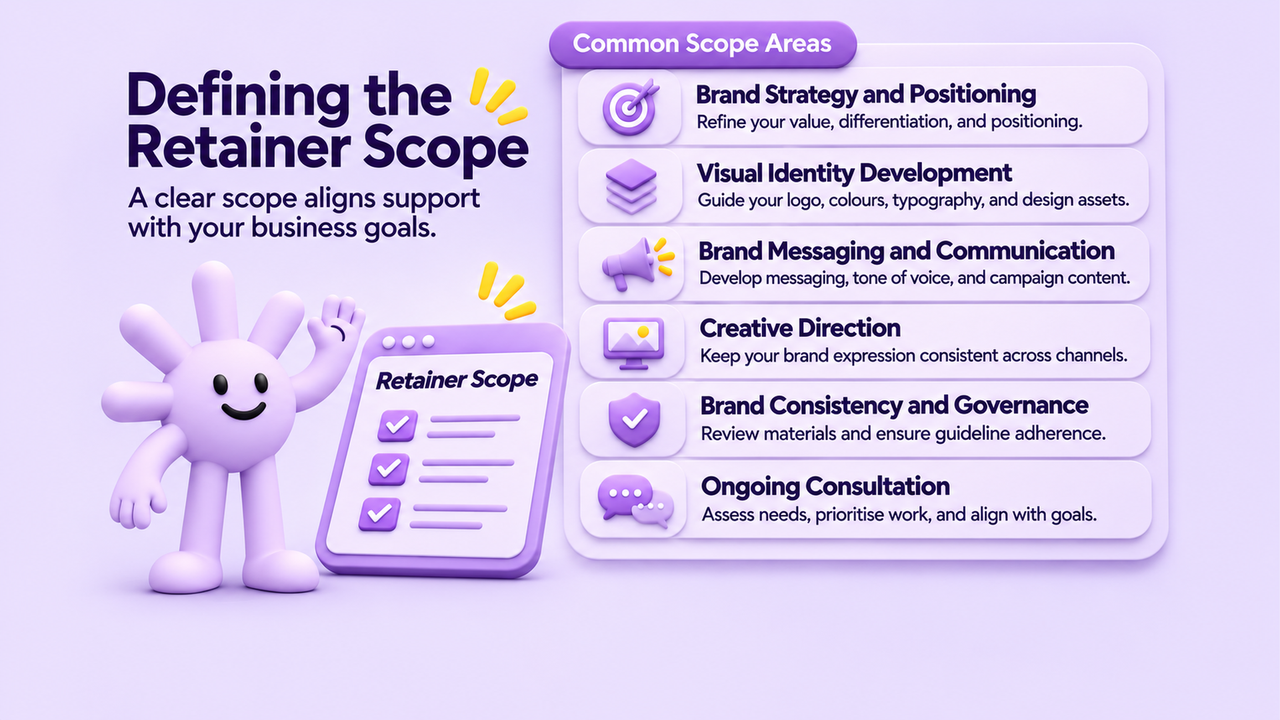
A well structured agreement may include brand strategy and positioning, helping businesses refine their value proposition, differentiation, audience understanding, and market positioning as priorities change. It may also cover visual identity development, providing guidance on applying and evolving brand elements such as typography, colour systems, imagery, and supporting design assets.
Brand messaging and communication are equally important, involving the development of messaging frameworks, tone of voice guidelines, campaign narratives, and communication materials that reinforce the brand's positioning. Alongside this, creative direction helps ensure that the brand is expressed consistently across campaigns, digital platforms, presentations, and other customer touchpoints.
Another important component is brand consistency and governance, which involves reviewing existing materials to identify inconsistencies and ensuring that internal teams and external partners follow established guidelines. Ongoing consultation can also form part of the arrangement, allowing businesses to assess changing requirements, prioritise upcoming initiatives, and align creative activities with business objectives.
Businesses should confirm which services are included, how much strategic input is available, and whether specialised projects require separate quotations. A clear scope helps prevent a retainer from becoming an undefined arrangement in which expectations exceed the available capacity.
Should Businesses Choose Strategic Support or Ongoing Creative Execution?
Retainers can vary significantly in their emphasis. Some focus primarily on strategic guidance, while others concentrate on implementing an established identity across marketing channels.
A strategy focused retainer may be appropriate for businesses refining their positioning, entering new markets, adjusting their value proposition, or developing a clearer brand architecture. These organisations need strategic thinking before determining how the brand should be expressed visually and verbally.
An execution focused retainer may suit businesses with an established strategy that require ongoing creative support. This could include campaign assets, branded presentations, marketing collateral, and the consistent application of existing guidelines.
Some businesses may need a combination of both. For example, an organisation undergoing rapid growth might require periodic strategic reviews alongside regular creative execution.
The important distinction is that strategic development and design production are related but not interchangeable. Design can communicate a brand's identity, but it cannot independently resolve fundamental issues with positioning, differentiation, or messaging.
Businesses should therefore identify whether their primary challenge is defining the brand, applying it consistently, or evolving it to support new objectives before choosing a retainer.
How Much Should Businesses Spend on a Brand Development Retainer?
The cost of a retainer depends on the scope of work, level of strategic involvement, complexity of the business, expected deliverables, and experience of the provider.
A retainer focused on maintaining existing brand assets requires a different level of involvement from one that includes strategic consultation, messaging development, creative direction, and brand architecture.
Businesses should compare proposals based on the services included rather than monthly fees alone. A lower priced option may provide sufficient design execution but limited strategic guidance. A more comprehensive arrangement may offer greater value when the business needs support with positioning, communication, and long term growth.
It is also important to understand how additional work is priced. Major rebranding initiatives, extensive research, new identity systems, and specialised campaign development may fall outside the recurring scope.
Rather than choosing the cheapest available option, businesses should assess whether the proposed investment addresses their most important challenges and provides an appropriate level of support for their stage of growth.
How Can Businesses Evaluate a Branding Partner?
Choosing a branding partner requires more than reviewing visual portfolios. Businesses should assess the provider's ability to understand commercial objectives and translate them into a coherent brand direction.
One important consideration is strategic understanding. The provider should be able to explain how branding connects to positioning, customer perception, differentiation, and wider business objectives. Relevant experience also matters, particularly whether the team has worked with businesses facing similar challenges or operating in comparable markets. Equally important is creative consistency, ensuring that the provider can develop work that reinforces a recognisable identity across different platforms and communication formats.
Businesses should also evaluate communication and collaboration processes, including how briefs are shared, concepts are reviewed, feedback is provided, and deliverables are approved. Performance evaluation is another key factor, as providers should establish meaningful objectives and periodically assess whether branding activities are supporting the intended outcomes.
In addition, businesses should clarify who will lead the engagement, how frequently strategic reviews will take place, and how changes in priorities will be managed.
The right partner should be able to explain not only what will be delivered but also why the work matters and how it supports the organisation's broader direction.
What Are the Common Mistakes to Avoid When Choosing a Retainer?
A recurring arrangement can create long term value, but only when it is structured around genuine business requirements. Businesses should avoid choosing based on price alone, as the cheapest option may not provide the capacity, expertise, or reliability required to meet business needs.
Another common mistake is confusing design production with strategy. Producing a steady stream of branded assets does not necessarily strengthen positioning or improve differentiation. Similarly, choosing without defining clear objectives can make it difficult to evaluate the retainer's value and determine whether it is meeting business expectations.
Leaving the scope unclear, particularly around deliverables, consultation, revisions, and additional projects, can lead to disagreements and unexpected costs.
Businesses should also avoid expecting immediate commercial results, as branding can support recognition, differentiation, and customer trust, but these outcomes often depend on sustained execution and other business factors.
Finally, failing to review the relationship can result in a retainer that no longer reflects changing business priorities or requirements. The scope and effectiveness of the arrangement should therefore be assessed periodically.
Avoiding these mistakes requires clear objectives, transparent agreements, and a shared understanding of how creative activities contribute to business growth.
How Can Businesses Measure the Value of a Retainer?
Measuring the value of ongoing branding support requires more than counting the number of assets produced each month. Businesses should evaluate both the quality of implementation and its contribution to wider marketing and commercial objectives.
Operational indicators may include consistency across brand touchpoints, turnaround times for creative requirements, adherence to guidelines, and the efficiency of internal approval processes.
Brand performance indicators may include aided and unaided brand awareness, audience recognition, brand consideration, customer perception, and engagement with branded campaigns. Depending on the business model, organisations may also monitor qualified enquiries, conversion rates, customer retention, and changes in customer acquisition performance.
However, these metrics should be interpreted carefully. Changes in sales or engagement cannot automatically be attributed to branding alone, as pricing, distribution, product quality, advertising, and market conditions can also influence results.
Businesses should establish a baseline before beginning the engagement and agree on realistic review periods. This creates a more reliable basis for assessing progress, identifying opportunities, and determining whether the retainer continues to meet the organisation's needs.
When Should a Business Move from Project Based Branding to a Retainer?
Project based branding is often suitable when a business needs a specific outcome, such as a new logo, an identity system, or a rebranding initiative. A retainer becomes worth considering when the business requires continued strategic guidance or regular implementation after the initial project is completed.
For example, a growing company may have completed its identity but still need support applying it to new campaigns, developing communication materials, and maintaining consistency as its marketing activities expand.
Similarly, a business entering a new market may require ongoing consultation to ensure that its positioning, messaging, and visual communication remain relevant to different audiences.
Before moving to a retainer, businesses should review their recurring needs, existing brand maturity, internal capabilities, and expected workload. If requirements remain occasional or unpredictable, individual projects may provide greater flexibility.
The objective is to choose an arrangement that matches the actual frequency and complexity of branding requirements rather than committing to recurring services without a clear operational need.
How Can the Right Retainer Support Long Term Brand Growth?
A well structured brand development retainer can help businesses maintain a coherent identity while adapting their positioning, messaging, and creative communication as they grow. Its value lies in establishing continuity between strategy and everyday implementation.
The most suitable arrangement will depend on the organisation's current brand maturity, growth objectives, internal capabilities, and need for ongoing support. Businesses should prioritise a clearly defined scope, appropriate strategic involvement, transparent pricing, and a collaborative working relationship.
At TSA Media Group, we help businesses connect branding, creative direction, and marketing communication with their wider business objectives. Our approach focuses on developing a consistent brand presence that reflects the organisation's positioning, communicates its value, and supports its growth.
Let's connect and explore how we can support your brand strategy and creative requirements.
Share this Blog