


How Can You Maintain Brand Design Consistency Across Platforms?
Brand design is often treated as a creative output rather than a structured system. This assumption limits consistency, as visuals become dependent on individual execution rather than defined standards.
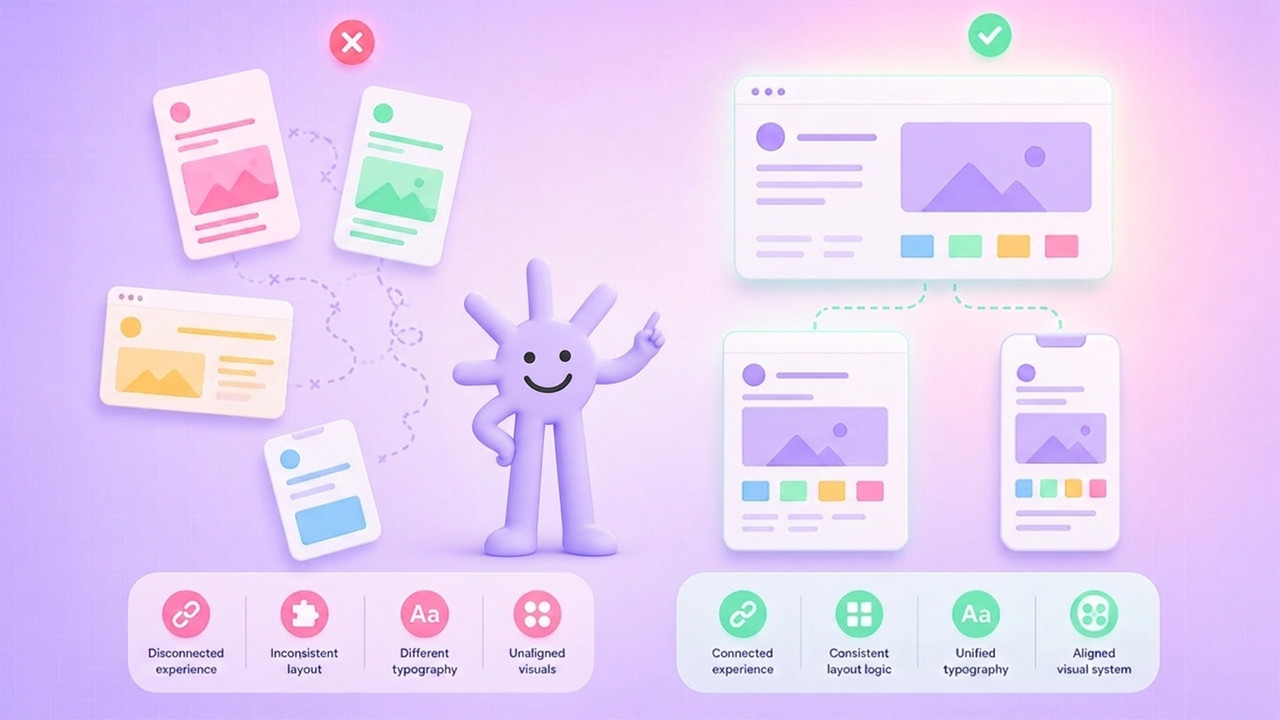
In practice, consistency is not achieved through repetition alone but through alignment. It reflects how clearly visual elements, layout structures and design decisions are defined and applied across different platforms. When these elements are not standardized, variation emerges and brand perception becomes fragmented.
For organizations, particularly working with paid media agencies, this shifts design from isolated production to system driven execution. Rather than focusing on individual assets, consistency is maintained by ensuring that every output follows the same underlying structure.
Visual guidelines define how consistency is applied
When design varies across platforms, the issue is rarely creativity. It is the absence of clear visual guidelines.
Guidelines establish how typography, colour, spacing and component usage should be applied. They remove ambiguity, allowing different teams to produce work that aligns without requiring constant oversight.
Without these guidelines, design decisions become subjective. This leads to inconsistencies that are not immediately visible in isolation but become apparent when assets are viewed together.
In this context, visual guidelines function as a control system, ensuring that variation is reduced at the source rather than corrected after execution.

Templates reduce variability in execution
Templates are often viewed as efficiency tools, but their primary function is control.
Reusable templates standardize layout, spacing and hierarchy. They ensure that each asset begins with a consistent structure, reducing the likelihood of deviation during execution.
This is particularly important across platforms where multiple formats exist. Without templates, each variation introduces the risk of inconsistency. With templates, variation is managed within a defined framework.
As a result, templates do not limit creativity. They define the boundaries within which creativity operates, ensuring that outputs remain aligned with the brand.
Typography and colour strengthen brand recall
Typography and colour are the most immediate signals of brand identity. When they vary, recognition weakens.
Consistency in typography ensures that hierarchy, readability and tone remain stable across all touchpoints. Similarly, controlled colour usage reinforces visual recall and prevents dilution of identity.
Inconsistent application of these elements creates subtle fragmentation. Individually, each asset may appear correct, but collectively, they fail to reinforce a cohesive brand.
Standardization addresses this by defining not only which elements to use, but how they should be applied in different contexts.
Structured layouts prevent inconsistency at scale
Layout is where most inconsistencies occur because it is often left open to interpretation.
Structured layouts define how elements are arranged, how spacing is maintained and how information flows within a design. This removes the need for repeated decision making at the execution stage.
When layouts are not structured, each asset becomes a new design problem. This increases variability and reduces alignment across outputs.
By contrast, structured layouts ensure that consistency is built into the design process rather than enforced after completion.
Aligning visuals across platforms builds trust
Different platforms introduce different constraints, but consistency does not require identical execution. It requires alignment.
This means adapting visuals to platform requirements while maintaining core design principles. Typography, colour, spacing and layout logic should remain consistent, even if formats change.
When alignment is maintained, audiences experience continuity across touchpoints. When it is not, each platform feels disconnected, weakening brand perception.
When brand consistency becomes a system
Brand design is often treated as a creative function because it is directly tied to visuals and aesthetics. This assumption limits its role.
In practice, consistency reflects how well an organization defines and applies structure across its design outputs. It reveals whether visual elements, layouts and design decisions are aligned or whether variation is being introduced through execution.
For leadership teams, this creates a shift from isolated design activity to system driven consistency. Instead of evaluating individual assets, organizations can assess how effectively their design system supports recognition, scalability and alignment across platforms.
This changes how brand design is interpreted. It is no longer viewed solely as a creative output, but as a system that determines how consistently a brand is perceived across touchpoints.
At TSA Media Group, brand consistency is approached as a structured system, where visual guidelines, templates and layout frameworks guide how designs are created and applied. By aligning design execution with clearly defined standards, we help organizations, as one of the best paid media agencies, to reduce inconsistency, strengthen recognition and build trust across digital platforms.