

Current Web Development Trends: What Agencies Should Know
From AI-powered front-ends to hybrid JAMstack and stricter accessibility rules, 2025 is a year of practical shifts for agencies. Here are the high-impact trends and what to do about them.
AI-Powered Front-Ends Move From Demos to Deliverables
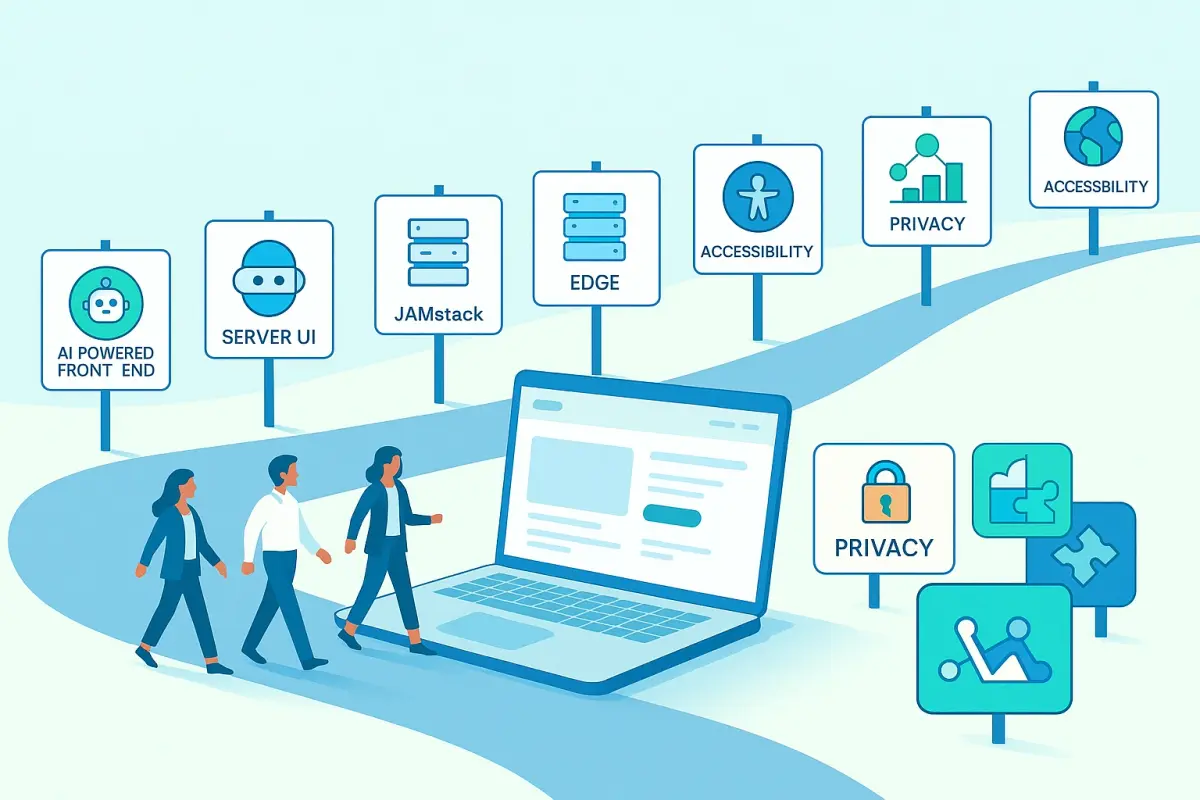
Modern sites are shipping AI features (chat, reranking, summarisation, voice) as first-class UX. Tooling like TypeScript-native SDKs and UI primitives make streaming UIs, tool calling, and provider-agnostic pipelines production-ready. Start small: add an AI assist to search or support, then expand to on-site agents.

Server-Driven UI (RSC) and Server Actions
React Server Components and Server Actions reduce client JS, keep mutations close to data, and improve perceived speed. The pattern: fetch and render on the server by default; hydrate only what must be interactive. Audit pages for components that can go server-first, then migrate forms to server actions.
JAMstack → Islands & Hybrids
Static where possible, dynamic where it counts. Islands architecture (e.g., Astro) ships mostly HTML and hydrates only interactive bits; frameworks like SvelteKit blend SSR with client routing. Use this for content sites and docs that need speed without SPA bloat.
Edge Compute + Edge Data
Workers at the edge shorten round-trips for routing, auth, AB tests, and personalization. Pair with edge-friendly data (KV, Durable Objects, or a lightweight SQL edge DB) to keep state close to users. Start by moving middleware and simple data lookups to the edge.
Accessibility Becomes Mandatory (Not "Nice to Have")
Regulatory pressure stepped up in 2025 (e.g., EU rules). Treat accessibility as a product requirement: aim for WCAG 2.2 AA, design contrast early, keyboard-first navigation, and continuous audits. Build accessibility checks into CI to avoid costly retrofits.
Performance: INP Joins the Critical Path
Interaction to Next Paint (INP) replaced FID in Core Web Vitals, so responsiveness under load matters more. Tactics: split long tasks, ship less JS, prefetch critical routes, and measure real-user INP. Treat LCP, CLS, and INP budgets as non-negotiable.
Privacy Reality Check: Plan for First-Party Data
Cookie policies shifted: rather than a hard deprecation, browsers are emphasizing user choice and privacy APIs. Regardless, the durable strategy is first-party data, consent UX, and server-side tagging. Build conversion tracking that survives policy swings.
WebAssembly & the Component Model
Wasm is maturing beyond the browser with the Component Model and WASI updates, making polyglot modules easier to compose. Use cases: heavy client features (editors, media, ML), secure plugins, and cross-runtime code reuse. Pilot where performance is a blocker.