

What Influences Website Development Costs and Why Does Pricing Vary?
One of the first questions businesses ask when planning a new website is how much will it cost? The difficulty is that website development does not have a single standard price. Two websites that appear similar at first glance can require very different levels of planning, design, development, testing, and technical functionality.
This is why website development quotes can vary significantly between freelancers, agencies, platforms, and development teams. The final cost depends on what the website needs to achieve rather than simply how many pages it contains.
For businesses considering custom web development, understanding the factors behind pricing can make it easier to compare quotations, establish a realistic budget, and determine which features are genuinely important for the project.
Why Do Website Development Costs Vary So Much?
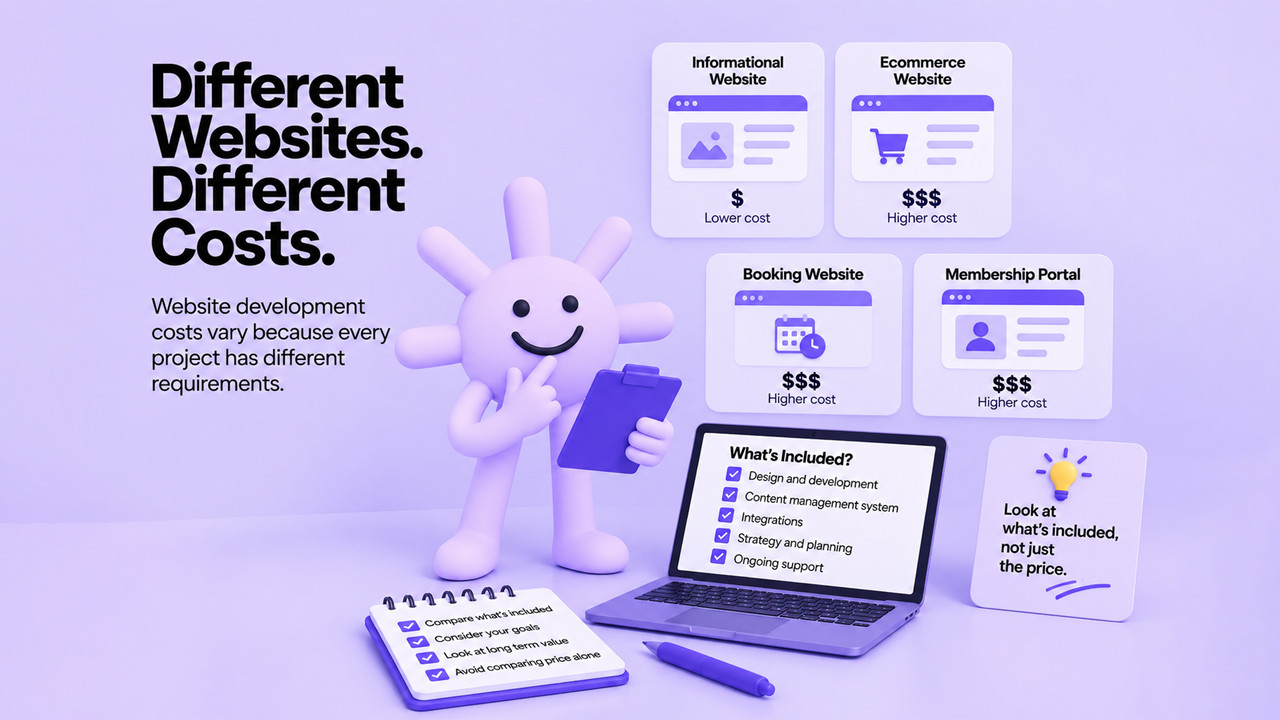
Website development costs vary because every project comes with a different combination of requirements.
A straightforward informational website for a small business may require only a few core pages, basic contact functionality, and a relatively simple content management system. An e commerce platform, booking website, membership portal, or business platform may require significantly more development work.
The level of strategy involved can also affect pricing. A website developed around specific customer journeys, conversion objectives, integrations, and business processes requires more planning than one created primarily to establish an online presence.
This means businesses should be cautious about comparing website prices without first comparing what is actually included in each project.
How Does Website Design Affect Development Costs?
Design can have a significant impact on the overall cost of a website.
Template based websites generally require less design and development time because much of the underlying structure has already been created. They can be suitable for businesses with straightforward requirements and limited budgets.
A fully customised website requires a different process. Designers and developers may need to create layouts, navigation structures, interactive elements, responsive experiences, and user journeys specifically for the business.
The more unique the design and user experience requirements become, the more time is generally required to plan, develop, test, and refine the website.
Businesses should therefore consider whether they simply need an attractive website or whether they require an experience specifically designed around their customers and commercial objectives.
Do Website Features Increase the Price?
Functionality is another major factor influencing development costs.
A website that only provides information about a business is generally less complex than one that allows customers to purchase products, make appointments, create accounts, submit detailed enquiries, access personalised information, or interact with external systems.
Even features that appear relatively simple to users can require substantial work behind the scenes. Payment processing, inventory management, customer portals, API integrations, advanced search functionality, and automated workflows all introduce additional technical requirements.
This is one reason website quotations should clearly explain what functionality is included rather than presenting only a final price.
Does the Number of Pages Determine Website Development Cost?
Page count can influence pricing, but it should not be treated as the only measure of development complexity.
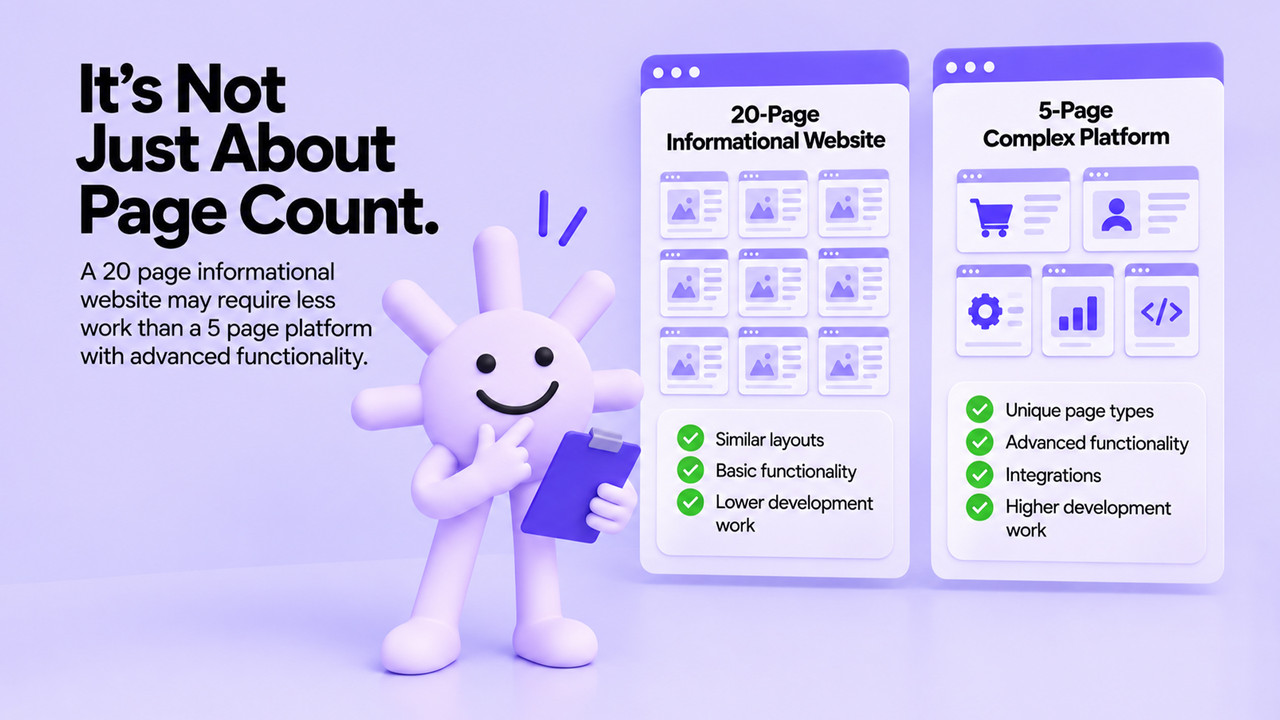
A 20 page informational website may sometimes require less development work than a five-page platform containing sophisticated functionality and integrations.
The type of page matters as much as the number of pages. If several pages use the same layout and functionality, they may be relatively straightforward to create. Unique landing pages, interactive sections, product systems, or specialised interfaces may require considerably more work.
Businesses should therefore evaluate website scope based on complexity and functionality, not page count alone.
Why Does Custom Web Development Cost More?
The purpose of custom web development is to build a website around the specific requirements of a business rather than adapting the business to the limitations of a pre existing template.
This can involve developing tailored functionality, creating unique interfaces, integrating third-party systems, improving performance, and designing the website around specific customer journeys.
The initial investment may therefore be higher than using an off-the-shelf template. However, the comparison should consider what the business actually requires.
A lower cost website can become expensive if it needs repeated modifications, additional plugins, workarounds, or a complete rebuild because the original solution cannot accommodate future requirements.
The appropriate approach depends on the complexity of the business and how important the website is to its operations, customer experience, and revenue generation.
Does SEO Affect Website Development Pricing?
SEO should ideally be considered during website development rather than being treated entirely as an activity that begins after launch.
Website structure, mobile usability, page speed, navigation, internal linking, crawlability, metadata implementation, and content architecture can all influence how effectively a website supports organic search visibility.
Building these considerations into the development process can require additional planning, but correcting structural problems after a website has launched can be more complicated.
Businesses that expect organic search to become an important acquisition channel should therefore discuss SEO requirements during the initial planning stage.
Why Are Very Cheap Website Quotes Worth Examining Carefully?
A low website development quote is not automatically a bad option. For a business with very simple requirements, an affordable template-based website may be entirely appropriate.
The problem arises when businesses compare prices without understanding differences in scope.
One quotation may include strategy, custom design, responsive development, content support, testing, SEO foundations, analytics setup, security measures, and post launch assistance. Another may cover only basic website construction.
Businesses should ask what is included, what is excluded, how revisions are managed, whether ongoing support is available, and whether additional functionality will create further costs.
The objective should be to identify the option that provides the right level of value for the business rather than automatically choosing the lowest initial price.
Should a Website Be Viewed as a Cost or a Business Investment?
For many companies, a website is no longer simply an online brochure. It can influence how customers discover the business, evaluate its credibility, submit enquiries, make purchases, book services, and interact with the brand.
This makes it useful to evaluate website development in terms of the role the website will play within the business.
If the website is expected to generate leads or sales, development decisions should consider conversion performance and customer experience. If it supports internal processes, integrations and operational efficiency may become more important. If its primary role is brand credibility, design and content presentation may receive greater emphasis.
The appropriate development budget should ultimately reflect the commercial importance of the website.
How Can Businesses Get a More Accurate Website Development Quote?
The clearer the project requirements are, the easier it becomes for a developer or agency to provide an accurate quotation.
Businesses should be able to explain the purpose of the website, the intended audience, essential functionality, expected integrations, content requirements, and any existing technical systems that need to be considered.
It is equally important to distinguish between essential requirements and features that would simply be useful to have. This helps establish priorities when the available budget cannot accommodate every idea at once.
At TSA Media Group, we develop websites around business requirements, customer experience, functionality, and long-term digital objectives rather than applying the same solution to every project.
Share this Blog